Chefy
A focused software project built around a real workflow.
How the project is put together
6 layers / 5 directed links
100%
- 01Interface
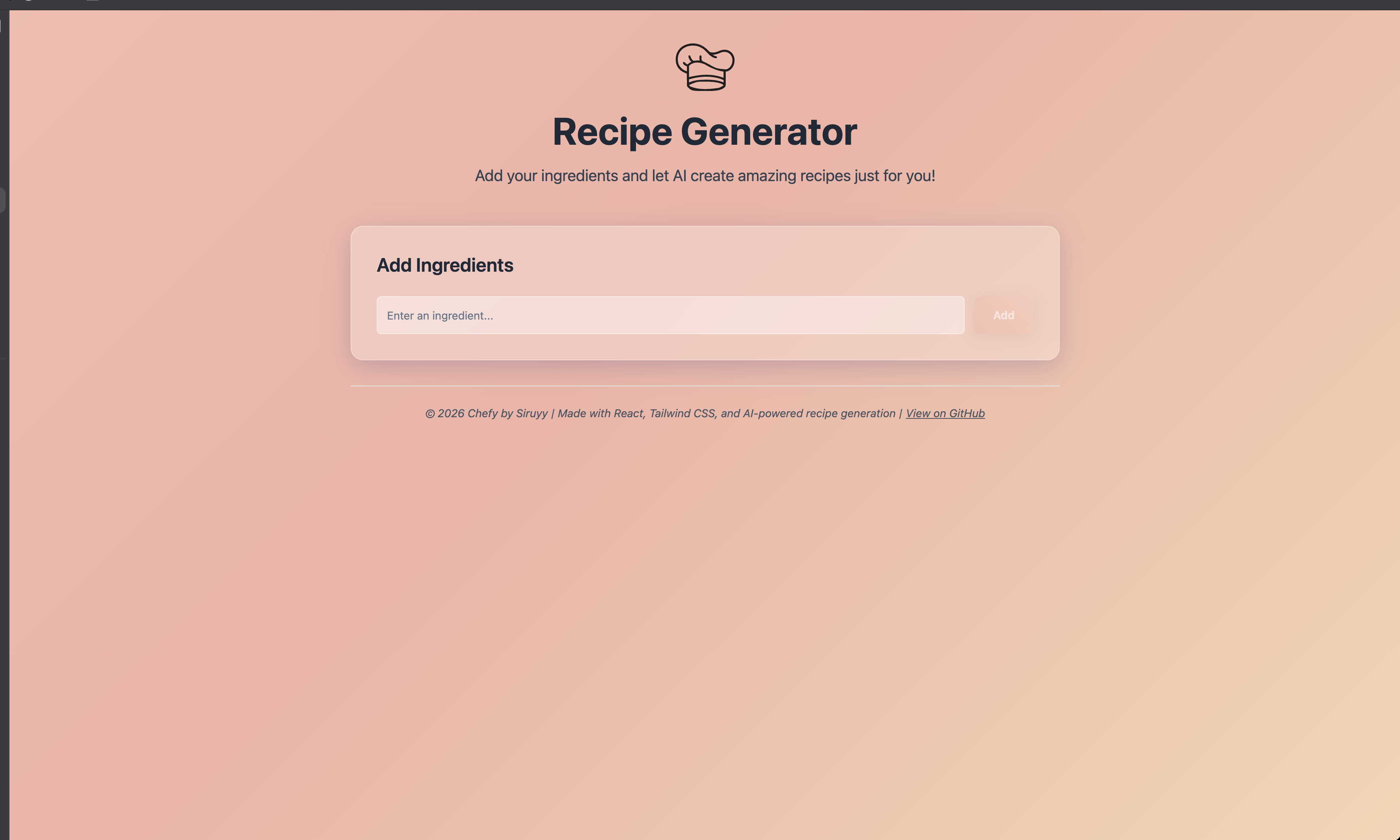
Ingredient input and generated recipe result UI.
React / TypeScript / Tailwind / shadcn/ui - 02Application
Ingredient validation, request state, and generated output handling.
Client state / Validation / Error boundaries - 03Services/API
Server-side OpenAI proxy protects API keys and structures recipe generation.
Vercel functions / OpenAI - 04Data
Generated recipes are request-scoped in the current implementation.
No persistent database - 05Auth/Permissions
No user auth; API credentials remain on the server.
Server-side API key handling - 06Runtime
Serverless deployment for a focused AI utility.
Vercel / Analytics / Speed Insights
From broken workflow to operating system
A workflow needed clearer structure and better software support.
A shipped system made the workflow easier to operate and maintain.
The workflow constraint
Home cooks waste food because they don't know what to make with what they have. Existing recipe apps require you to search by dish name, not by ingredients on hand.
What changed
Decisions and trade-offs
Serverless API routes over dedicated backend
Only one API call needed (recipe generation) — a full backend server would be overkill.
Decision: Used Vercel serverless functions to proxy OpenAI calls, keeping the architecture simple and cost-effective.
Trade-off: Cold start latency on first request, but zero infrastructure management and free tier sufficient for traffic.
Shadcn UI over building custom components
Needed polished, accessible UI components quickly without heavy dependencies.
Decision: Adopted Shadcn UI (copy-paste Radix primitives) for full control over styling while getting accessibility for free.
Trade-off: More initial setup than a full component library, but zero runtime dependency and full customization.
Constraints, architecture, and proof
React SPA built with Vite, Shadcn UI (Radix primitives) and Tailwind CSS for the interface, serverless API routes for OpenAI integration, deployed on Vercel with Vercel Analytics and Speed Insights.
Deployment, security, and maintenance
Server-side API key handling, input validation for ingredient lists, error boundaries for failed generation attempts, Vercel Analytics for monitoring.